
Insights into Regulation
The Knowledge Problem
The latest blog from the RPI explores the knowledge problem, tracing insights from Adam Smith to Hayek and what they mean for central planning and policy.
The latest blog from the RPI explores the knowledge problem, tracing insights from Adam Smith to Hayek and what they mean for central planning and policy.

This blog discusses Adam Smith’s insights on money and the absence of a market theory in his Wealth of Nations, highlighting the need for historical context and understanding of markets’ roles in reducing transaction costs.

Incoherence in governance hampers effective policymaking, echoing historical patterns of folly. To improve outcomes, a balanced approach integrating diverse perspectives is essential for coherent, productive decision-making.

Chapter 4 of the Wealth of Nations discusses money’s role in reducing exchange transaction costs, illustrating that institutional structures significantly influence economic behaviour, an idea later echoed by Ronald Coase in 1937.

Smith’s Theory of Moral Sentiments, published in 1759, explores human nature and moral judgement through the concept of a spectator who imagines the feelings and actions of others. It introduces the Impartial Spectator, a tool for self-evaluation. Smith’s insights, supported by modern neuroscience, inform our understanding of morality and community.

Umpteen scholars have made the point that the Invisible Hand metaphor, which is used only once in the Wealth of Nations at around the middle of that long work, is frequently misinterpreted and/or misunderstood in contemporary economic discourse.
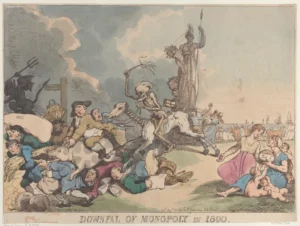
Monopoly is a major theme in the Wealth of Nations, as reflected in 175 usages of the word in the work, and, when applied to a single business, Smith’s opening analysis will be well known to students of economics today

The full title of Adam Smith’s major work is An Inquiry into the Nature and Causes of the Wealth of Nations (the “WoN”). Today we observe governments

Marking the 250th anniversary year of the publication of the Wealth of Nations, in the second of a series of blogs on the contemporary relevance of Adam Smith’s work, the Insights team take a look at his nuanced, changing assessment of the English Navigation Acts

In The Wealth of Nations, Adam Smith put forward four general principles that he judged a tax system should satisfy. While the economic system then was much smaller and much less complex than now – the revenue required by the state funded a much narrower range of activities – principles are relatively enduring across changes in contexts.

Scaling geologic time to (say) one year, homo sapiens has existed for less than an hour. In that twinkling of an eye, we have developed some capacity for foresight – an enormous evolutionary leap in one of nature’s creatures.

“Change” was the slogan of the British Labour Party in the recent General Election. It certainly didn’t do serious damage to electoral prospects; but it

Entrepreneurship is something of a ‘ghost in the machine’ so far as most economic theorising is concerned. It’s widely mentioned and tends to be encouraged by politicians, but detailed analysis of the concept is largely missing from standard economics. So, we ask: what is its nature, why is it important, and what (very briefly) might be done to encourage it?

A quick web-search for the meaning of the word elegant yields the following (from Oxford languages): Adjective : (1) graceful and stylish in appearance or

Alongside the Prisoners Dilemma, study of the Ultimatum Game (UG) and its variants is a rich source of experimental observations on human attitudes and conduct

Slogans can provide politicians with useful ways of signalling policy objectives. The “tough on crime, and tough on the causes of crime” slogan used by

The human brain has evolved over eons into a hemispheric structure, allowing a lateralisation of attention to our surroundings. The right-hemisphere (RH) ‘presences’ the world

The Tao Te Ching is an ancient classic of Chinese Daoism whose authorship is conventionally attributed to a certain Lao Tzu. It contains advice on how to be a Sage, a person with sagacity. Significant sections are clearly directed at leaders in governance.

‘No battle plan survives contact with the enemy’ was a sentiment expressed by Field Marshall von Moltke (the Elder), who knew a thing or two

As set out in To ‘see’, or not to ‘see’: that is the question. Moving on from a half-brained system of economic governance – (rpiresearchgroup.org), the half-brained governance thesis (“H-BGT”) is suggestive of a wide range of relevancies to areas of public policy where development thinking seems to be struggling. One such is the question of whether regulatory and competition policy decisions by designated agencies should be subject to review on their merits, as administrative decisions, not just on their conformity with acceptable procedures.

Net migration flows (about the regulation of which members of the RPI have been writing since 2017) are again a hot topic in political debate. In this latest blog, the Insights team briefly sketches out a potential, alternative way of looking at the issues: a different ‘gestalt’, based on a tradeable right to residency, which does not need to rely heavily on enforcement by coerced deportations (difficult in practice) or creating ‘hostile social environments’. Rather, it simultaneously seeks to make unlawful immigration more financially expensive and emigration of residents more financially rewarding, in each case relative to the status quo. Even in a bare bones form, it could give government three immediate ‘control variables’: the total number of rights available, the level of financial penalty for unlawful immigration, and the level of the bid-ask spread in the purchase or sale of the relevant right.

We have written before about the need for effortful and holistic thinking in the context of global decarbonisation, and about the perils of disconnecting local actions from global outcomes by retreat into a ‘net-zero in one country’ mindset. In this RPI Insights blog we highlight the dangers of partial thinking associated with indulgence of the false prophet of universal technology solution(s), blindness to potential ‘concentration risk’ and the resulting creation of systemic vulnerabilities, inadequate thinking around the physical resilience of energy infrastructure in the face of a changing climate, and reluctance to acknowledge either the regional realpolitik of the energy transition or the implicit policy tensions, uncertainties, and trade-offs around how it unfolds.

In a recent blog, the Insight Team highlighted the dangers of poorly constructed policies in terms of the increased distractions imposed on managers at the expense of a focus on business investment and innovation. In this follow-up, we consider recent financial market turbulence as another example of policy gone wrong. We argue that help in assessing and learning from it might lie in an appreciation of both history and the present – from the work of Adam Smith to recent developments in modern neuroscience, in particular the insights of Iain McGilchrist.

Policy debates about the burden of regulation have tended to focus on estimates of administrative costs imposed upon firms and have tended to rely on an assumption that simply eliminating some of the regulations (“cutting red tape”) will lead to significant reductions in the costs imposed. Here, the Insights Team take a different perspective, recalling both RPI empirical research on these issues for the UK Cabinet Office nearly 20 years ago and the earlier “Penrose Effect”, named after Professor Edith Penrose. They argue that much more substantive effects arise from poorly considered and conducted changes in regulations in consequence of their increased calls on limited senior management bandwidth available for addressing the challenges involved in investing, innovating and expanding a business.

The first Insights blog of the new year continues to emphasise a central theme of earlier pieces: the dangers of taking an overly narrow view of policy challenges, whether that be the result of failure to recognise wider, salient features of a broader context, or of taking unduly narrow view of target outcomes in policy responses to the challenges. The same theme is to be found in earlier RPI critiques of ‘pixelation’ in regulatory assessment, grounded in an analogy with perceptions of a digital picture which are drawn to a relatively small bloc of pixels and focus disproportionately on it, to the neglect of all else. The blog contains a striking quotation from Keynes, who was ever unpixelated.