
Insights into Regulation
The Knowledge Problem
The latest blog from the RPI explores the knowledge problem, tracing insights from Adam Smith to Hayek and what they mean for central planning and policy.
The latest blog from the RPI explores the knowledge problem, tracing insights from Adam Smith to Hayek and what they mean for central planning and policy.

This blog discusses Adam Smith’s insights on money and the absence of a market theory in his Wealth of Nations, highlighting the need for historical context and understanding of markets’ roles in reducing transaction costs.

Incoherence in governance hampers effective policymaking, echoing historical patterns of folly. To improve outcomes, a balanced approach integrating diverse perspectives is essential for coherent, productive decision-making.

Chapter 4 of the Wealth of Nations discusses money’s role in reducing exchange transaction costs, illustrating that institutional structures significantly influence economic behaviour, an idea later echoed by Ronald Coase in 1937.

Smith’s Theory of Moral Sentiments, published in 1759, explores human nature and moral judgement through the concept of a spectator who imagines the feelings and actions of others. It introduces the Impartial Spectator, a tool for self-evaluation. Smith’s insights, supported by modern neuroscience, inform our understanding of morality and community.

Umpteen scholars have made the point that the Invisible Hand metaphor, which is used only once in the Wealth of Nations at around the middle of that long work, is frequently misinterpreted and/or misunderstood in contemporary economic discourse.
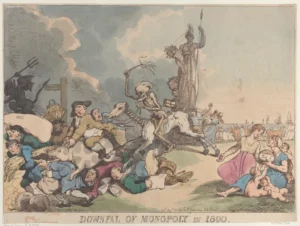
Monopoly is a major theme in the Wealth of Nations, as reflected in 175 usages of the word in the work, and, when applied to a single business, Smith’s opening analysis will be well known to students of economics today

The full title of Adam Smith’s major work is An Inquiry into the Nature and Causes of the Wealth of Nations (the “WoN”). Today we observe governments

Marking the 250th anniversary year of the publication of the Wealth of Nations, in the second of a series of blogs on the contemporary relevance of Adam Smith’s work, the Insights team take a look at his nuanced, changing assessment of the English Navigation Acts

In The Wealth of Nations, Adam Smith put forward four general principles that he judged a tax system should satisfy. While the economic system then was much smaller and much less complex than now – the revenue required by the state funded a much narrower range of activities – principles are relatively enduring across changes in contexts.

In this paper, Daniel Pryor argues that competition interventions in digital markets have often been premised on faulty economic assumptions and therefore led to various unintended consequences

In this new piece in our Past Learnings Series, George Yarrow discusses the publicly perceived “untrustworthiness” of politicians

Scaling geologic time to (say) one year, homo sapiens has existed for less than an hour. In that twinkling of an eye, we have developed some capacity for foresight – an enormous evolutionary leap in one of nature’s creatures.

The 6th piece in our series Past Learnings, this piece is an extensive re-working of a paper first published in September 2016, which was likewise a thought experiment on a potential regulatory approach to the control of migration flows

The RPI’s latest piece in our Past Learnings Series discusses the complexity of economic systems and the common inability of policy-makers to fully account for that complexity when making policy changes.

“Change” was the slogan of the British Labour Party in the recent General Election. It certainly didn’t do serious damage to electoral prospects; but it

This is a write-up of the session “Statistics in Regulation and Policy“, given at the RPI Annual Competition and Regulation Conference 2024. This may seem

Our 4th paper in our Past Learnings series, this short paper discusses the division of labour within the organisational and institutional structures that we call

This piece in the Past Learnings Series is based on a hitherto unpublished internal Regulatory Policy Institute Paper dating from 2012.

Entrepreneurship is something of a ‘ghost in the machine’ so far as most economic theorising is concerned. It’s widely mentioned and tends to be encouraged by politicians, but detailed analysis of the concept is largely missing from standard economics. So, we ask: what is its nature, why is it important, and what (very briefly) might be done to encourage it?

A quick web-search for the meaning of the word elegant yields the following (from Oxford languages): Adjective : (1) graceful and stylish in appearance or

The notion that promoting competition is a Good Thing has become a consistent theme in economic policymaking in recent decades, accompanied by an implication that “the more of it the better” should be a presumptive policy stance. In contrast, very many members of the public appear to find these propositions far from obvious, not least those who are owners of, or workers for, business enterprises.

The notion of ‘fairness’ is widely referenced in public policymaking and enforcement, but with no settled meaning. What we see is incoherent application of the notion across economic contexts, a form of policy disorder with which we are well familiar. Moreover, the disorder (‘entropy’) appears to be increasing over time.

Alongside the Prisoners Dilemma, study of the Ultimatum Game (UG) and its variants is a rich source of experimental observations on human attitudes and conduct

Slogans can provide politicians with useful ways of signalling policy objectives. The “tough on crime, and tough on the causes of crime” slogan used by