From a policy perspective, the central theme of the Wealth of Nations (“WoN”) can be (correctly) read as a thoroughgoing critique of the whole mercantile system of the Great Britain of his time, followed by the proposal that a scythe should be taken to its trade-restricting regulations. i.e. a call for extensive deregulation.
The central theme is strongly stated and it is very easy to neglect the nuances and subtleties in the WoN as a whole. That is unfortunate, because it is the latter that are often more directly relevant to contemporary policy issues and would benefit from more attention. Thus, in an earlier blog in this series, we have examined Smith’s positive enthusiasm for the 17thcentury Navigation Acts, legislation that was manifestly trade-restricting, and asked ‘Why the enthusiasm? Adam Smith and the Navigation Acts – Regulatory Policy Institute
In a similar vein, it is not widely known that Smith supported a cap on lending rates in financial transactions, which stood at 5% in 1776. That was a straight-out price control on lending/borrowing transactions, so what is going on here? Why the absence of a critique? Interestingly, the answers are linked to the intended purpose-in-use of the much-misunderstood invisible hand metaphor (The Invisible Hand Metaphor – Regulatory Policy Institute).
In this price-cap context, we find Smith putting heavy emphasis on the tasks of understanding how restrictive regulations came to be established in the first place and, a fortiori, evaluating their past, present and future functionality for system-wide economic performance. Implicitly, it is an application of the Chesterton’s Fence Principle: ‘do not remove a thing, rule, institution or tradition until you understand why it was established and what function it serves’. Inter alia, the Principle serves as a guard rail against unwanted, unintended consequences of narrowly focused reforms … against throwing unseen/’invisible’ babies out with the bathwater.
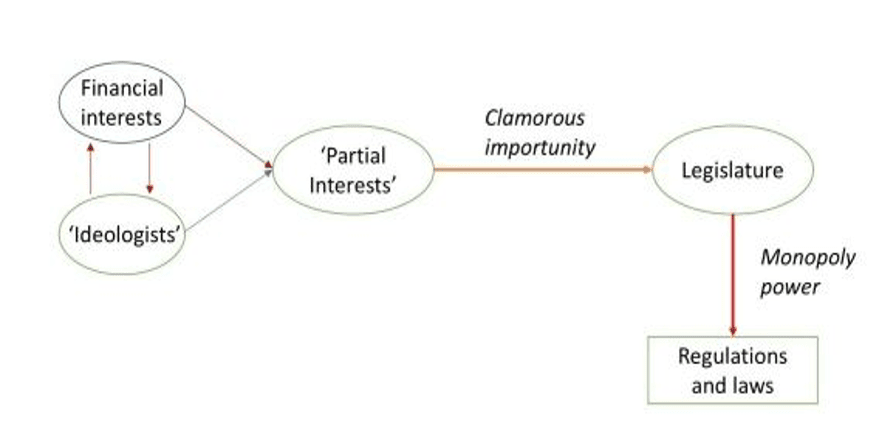
In the wider context of mercantile trade restrictions, Smith’s responsive answer to the first task can be summarised in a diagram, which sees ‘partial interests’ (meaning sub-groups of members of society who are partisan in their own causes) lobbying the legislature to introduce laws and regulations that will favour their own, particular interests. In so doing, they give little or no weight to the effects of adopting their own favoured ideas, although, in their rhetoric, they may support or create ideologies that suggest that others will benefit too. Thus, Mercantilism can be seen as the ideology of financially powerful merchants, referenced when putting pressure on legislators to ‘supply’ their desired outcomes.
The WoN simultaneously trashes the Mercantilist ideology and forcefully condemns the excesses of merchants in putting pressure on legislators, from bribery up to threats of physical violence. This is what Smith labelled ‘the clamorous importunity of partial interests’. It can be noticed in passing that the condemnation is directed at the political conduct of merchants, not at the economic activity of merchanting itself, of which Smith approved.
At the centre of the analysis lies the fact that the legislature exercises considerable monopoly powers. The partial interests therefore clamour for that monopoly power to be exercised in ways favouring their own particular interests, rather than the wider interests of society as a whole. That is the prize that they seek and there is, of course, a long history of sovereigns acting as suppliers of privileged sources of economic rents (as well as increased power) to favoured supporters. (The legislated privileges of the East India Company, a bête noire for Smith and Burke alike, provide obvious examples.)
Two forms of remediation for the problem (lack of consideration for the wider implications of this ‘regulation-generating process’) fall naturally from the analysis, and each is covered at various points in the text of the WoN. The first rests on the proposition that the greater the prize, the greater the effort that will be induced in search for its achievement. Inter-alia, the sizes of the prizes (the special privileges) to be won will depend upon the scope of application of the monopoly power (something that nowadays has been substantially enhanced by a greatly expanded executive arm of government). Reduce the scope of offered willingness to supply and the clamour will be mitigated, and the system-wide dysfunctions it gives rise to will be alleviated.
The second is that politicians can, and should, develop the backbone to say no to the clamour. On this Smith wrote that: “The proposal of any new law or regulation of commerce which comes from this order, ought always to be listened to with great precaution, and ought never to be adopted till after having been long and carefully examined, not only with the most scrupulous, but with the most suspicious attention. It comes from an order of men, whose interest is never exactly the same with that of the public, who have generally an interest to deceive and even to oppress the public, and who accordingly have, upon many occasions, both deceived and oppressed it.”
Turning now to the specific restrictions of trade with which we started, each is a ‘fence’ or ‘gate’ standing across a path to greater freedom of trade. But rather than treating that fact alone as sufficient for advocating that the fences should be taken down, Smith asks the Chesterton’s fence questions: Why are they here? What, if any, wider functionalities might they serve?
In the case of the Navigation Acts it is a simple story. They were a product of Anglo-Dutch commercial and naval rivalry, which descended into periodic episodes of naval warfare. And they were gradually liberalised once that period of conflict was over.
The history of the cap on lending rates is both more complex and more interesting. It starts with medieval prohibition of usury, which derived from religious norms. The prohibition was liberalised by Henry VIII’s Parliament in legalising lending at rates up to 10% (1545): only lending rates above that level were then deemed usurious. Edward VI’s Parliament restored the absolute prohibition (1552), then Elizabeth I restored her father’s 10% limit. Subsequent Parliaments reduced the legal limit to 8% (1624), 6% (1651), and 5% (1714), the latter being the rate that was applicable throughout Smith’s lifetime. The usury laws were finally abolished in 1854.
So, the questions are: Why didn’t Smith advocate abolition in 1776? What is the argument here?
The answer, we think, lies in the opening paragraphs of the Wealth of Nations, which establish Smith’s primary interest in productivity growth (Adam Smith’s ‘Theory of Productivity Growth’ – Regulatory Policy Institute).
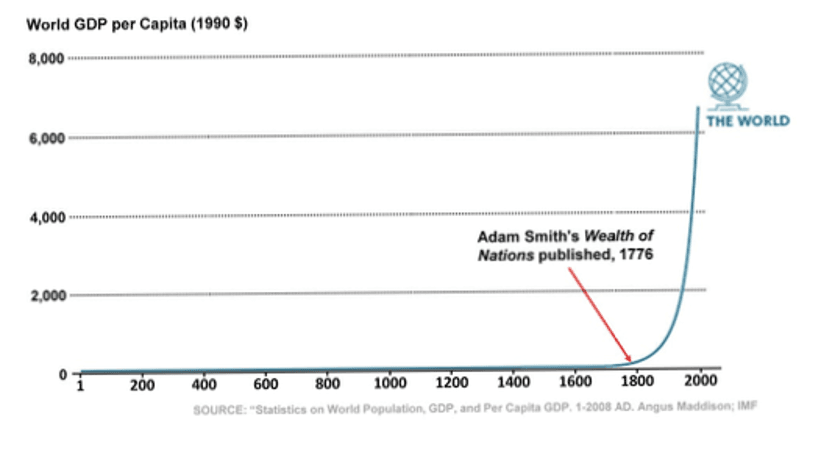
In the third quarter of the 18th century Smith foresaw the potential for a great leap forward in productivity growth and living standards arising from the introduction of new technologies in the emerging manufacturing sector of the economy (and he was spot on in this foresight – see the diagram below [1]).
The main driver for that was increasing human capital arising from a greater division of labour, and the famous pin factory illustration of the growth potential appears as early as the third paragraph of the WoN, which indicates just how important Smith considered this process to be. However, the development of manufacturing would also require hefty investment in physical capital, which in turn would entail hefty financial requirements.
The undeveloped nature of international capital markets of the time meant that the requisite finance would need to be sourced domestically and, in Smith’s judgment, the existence of high borrowing rates would lead to a greater fraction of domestic lending going to ‘prodigals’ (e.g. high spending progeny of the affluent) and ‘prospectors’ (those entranced by highly speculative ventures [2]), who would be less deterred by high borrowing rates. In consequence, it would be likely that less funding would be available for productive investment in manufacturing, slowing the productivity growth that could be achieved.
The analysis amounts to an identification of what, in much later economics, would be called an ‘adverse-selection’ problem, and Smith’ concluding judgment was that tearing down this particular fence (a capped lending rate) in the name of a step toward greater freedom of trade would put at risk the attainment of what he considered a much more economically important objective, increasing the rate of productivity growth. A very significant baby – the nascent developments in manufacturing of his time – could be seriously harmed by removing the fence.
[1] From a recent paper by Prof Mark Skousen: The Genius of Adam Smith — Adam Smith Institute
[2] The South Sea Bubble (1720) illustrates just how feverish the speculation could be. As brilliant a mind as Isaac Newton was drawn into it, and it cost him a fortune. He later wrote ruefully: “I can calculate the motions of the heavenly bodies, but not the madness of people”.